What a Marketing Consultant Actually Costs in 2026 — and What an Hour Should Buy You
Short answer, before anything else: a marketing consultant in 2026 typically charges $100–$300 an hour. That figure comes from MarketerHire’s 2026 pricing guide, not from my opinion. Monthly retainers usually run $3,000–$15,000, and agencies charge more on top of that.
Here’s the part most pricing pages skip. Most small businesses don’t need any of those yet. They need to know what one hour should buy before they sign anything bigger — because the expensive mistake is rarely the consultant’s rate. It’s paying retainer money to answer a question an hour would have settled.
I sell that hour. It’s $99, and I’ll explain where it sits on the ladder below — along with every rung above it, so you can judge any quote you ever get, including mine.
How much does a marketing consultant charge per hour?
It depends mostly on how much judgment you’re buying. MarketerHire’s freelance rates guide breaks it down by experience:
| Experience level | Typical hourly rate |
|---|---|
| Junior consultant | $50–$100 |
| Mid-level consultant | $100–$175 |
| Senior consultant | $175–$250 |
| Expert / fractional CMO level | $250–$350+ |
That’s a 7× spread between the top and the bottom, and it’s not random. You’re not really paying for hours — you’re paying for how many expensive mistakes the person has already made and can keep you from making. A junior consultant sells you hands and time. A senior one sells you pattern recognition.
Specialty moves the number too. MarketerMatch’s specialty breakdown puts most freelance specialties between $75–$250 an hour, with strategy and SEO at the higher end ($125–$250 and $100–$250) and social media lower ($50–$120). And marketers.com draws a line I think is the honest one: hands-on work runs about $75–$150 an hour in the US, while strategic, director-level judgment runs $150–$300. Same clock. Different thing being sold.
What does a monthly retainer actually buy?
Retainers are where the numbers get slippery, so let’s do the division out loud.
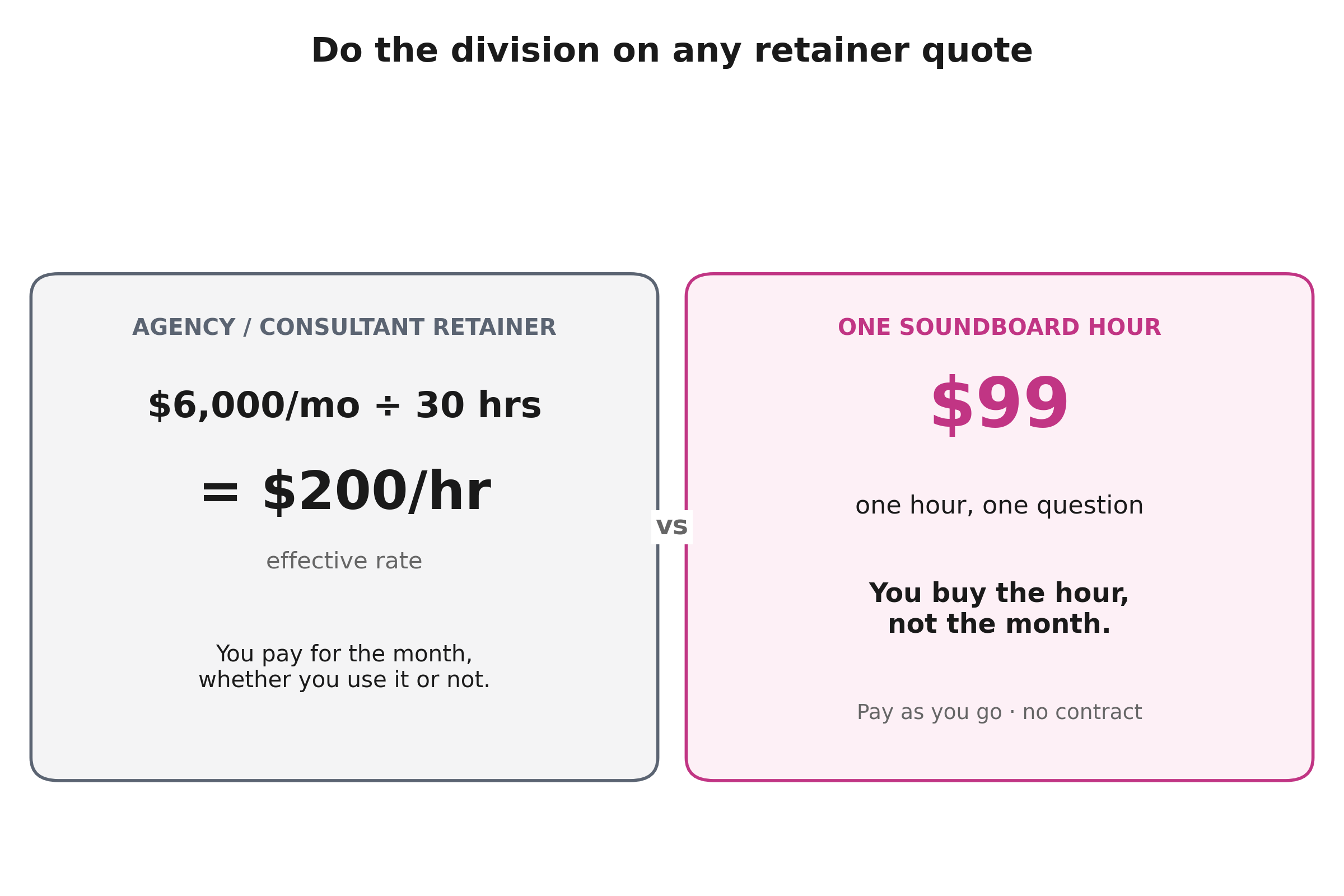
Consultant retainers typically run $3,000–$15,000 a month for somewhere between 10 and 40 hours, per MarketerHire. Now divide. A $6,000 retainer that buys you 30 hours of work is $200 an hour — that’s the worked example Christoph Olivier Consulting uses in its rate roundup, and it’s the math I’d encourage you to run on any proposal anyone hands you. A $6,000 retainer that buys you 12 hours is $500 an hour, and nobody would sign that if it were written on the page as an hourly rate. Retainers hide the rate. That’s not always sinister — sometimes it’s just packaging — but you should always know what the packaging costs per hour. Fair warning about my own math: a retainer also buys availability — someone carrying your marketing month to month, on call when something breaks — and that isn’t worth zero. The division doesn’t capture it. It just keeps the packaging honest.
When is a retainer the right buy? When there’s ongoing work that never stops: a channel that needs running every week, campaigns that need tending, content that ships on a schedule. Steady work deserves a steady arrangement. When is it the wrong buy? When what you actually have is three questions and a decision to make. Then a retainer is a subscription to meetings, and you’ll feel it by month two.
What does a fractional CMO cost — and is that what you need?
A fractional CMO is the most expensive rung on this ladder, and the most misunderstood.
MarketerHire’s specialty figures put fractional CMOs at $250–$400 an hour, commonly $10,000–$20,000 a month. The cross-check agrees: GoFractional’s data puts the average closer to $173 an hour, with the middle half between $125–$200 — roughly $7,500–$12,000 a month at 15 hours a week. Either way, it’s leadership money.
And leadership is the point. A fractional CMO runs a marketing function — sets strategy, manages people, owns results across channels. A consultant answers, advises, and points. Those are different jobs, and the second one costs a tenth of the first. If you don’t have a team or a serious budget for someone to lead, a fractional CMO isn’t a premium version of advice. It’s the wrong purchase, however good the person is. Most businesses reading this need the second job done well, not the first job bought early.
How do agencies compare?
Agencies charge for a team, and the team is real — designers, media buyers, copywriters, account people. So is the overhead. Crowdcreate’s 2026 agency pricing report puts North American agency rates at roughly $100–$200 an hour for a boutique shop, $150–$250 for mid-size, and $200–$400+ for large agencies. Agency retainers commonly run $2,000–$15,000 a month (marketers.com).
The honest caveat isn’t the price. It’s the layers. When you hire an agency, some of what you pay for is the building — the account manager who relays your words to the person who actually does the work. Sometimes that’s fine; breadth is worth paying for when you need five skills at once. Just ask, before you sign, who will actually touch your account. If the answer is vague, that’s information.
The whole ladder, side by side
| Way to buy help | Typical 2026 cost | What you get | Watch out for |
|---|---|---|---|
| One consultant hour (advice only) | About $100–$175 for a single hour (marketers.com); my Soundboard hour is $99 | One person’s judgment on your actual question, and clear next steps | An hour won’t execute anything for you |
| Freelance consultant (hourly) | $50–$300/hr by experience (MarketerHire) | Flexible expertise, pay only for time used | Quality varies wildly at the platform floor — Upwork’s median is $20–$60/hr (Christoph Olivier Consulting’s marketing rate roundup) |
| Consultant retainer | $3,000–$15,000/mo (MarketerHire) | Ongoing work and advice, priority access | Paying retainer prices for a few hours of actual work |
| Fractional CMO | $10,000–$20,000/mo, $250–$400/hr (MarketerHire) | Leadership of a whole marketing function | Expensive overkill if there’s no team to lead |
| Agency | $100–$400+/hr (Crowdcreate); retainers $2,000–$15,000/mo (marketers.com) | A team, breadth, execution capacity | Layers between you and the person doing the work |
What should one hour with a consultant actually buy you?
This is the section I care about most, because it’s the product I sell — so hold me to it too.
One hour should buy you one person’s undivided attention on your question. Not a template, not a tour of their services. Mine works like this: you bring the questions — marketing, content, business strategy, or just “I need someone to bounce this off” — and I bring whatever marketing and creative insight I’ve built up since 2013, pointed at the thing you’re stuck on. Think of it like renting my brain for an hour.
Whatever consultant you hire, by whatever name, here’s the checklist. You should leave the hour with:
- A decision, or a short list. Not “more clarity” in the abstract — an actual call made, or the two or three options with a recommendation.
- The next 2–3 steps, in order. Written down, in a sequence you can start on tomorrow.
- At least one thing you were told not to do. An hour where everything you said sounded great was not consulting. Honest pushback is most of the value — kindly delivered, but delivered.
If an hour doesn’t produce those three things, it wasn’t a consulting hour. It was a sales call wearing a consulting costume.
And the price, since this whole post is about saying prices out loud: my Soundboard hour is $99 — three sessions are $249, five are $399, pay as you go, no contract. A single trial hour with a consultant typically runs about $100–$175 (marketers.com), so yes, $99 sits deliberately below that band. That’s on purpose. The product is one honest hour with nothing behind it — no bigger package waiting, no funnel. I’d rather the hour be easy to say yes to and easy to walk away from.
What should it never cost you?
I’ve been on the buying side of services too, and the red flags are consistent. Walk away from:
- A “free consultation” that’s a pitch with a calendar invite. If the hour’s real agenda is selling you a package, it isn’t a consultation.
- A retainer quoted before anyone asked what you’re trying to do. A price without a diagnosis is just a number they like.
- Guaranteed rankings or guaranteed results. Nobody honest guarantees Google. Anyone who does is selling you the guarantee, not the result.
- A contract you can’t leave, for advice you haven’t tested yet. Test the advice first. Commitment should be earned.
- Vague hours. A retainer that won’t say how many hours it buys is asking you not to do the division from earlier. Do it anyway.
- Pressure to decide on the call. Good advice survives a night of sleep. Pressure exists because the seller is afraid it won’t.
I won’t do any of that, and you shouldn’t let anyone else do it to you either. (I realize a consultant writing “trust me, I’m honest” is a little rich. So don’t trust the sentence — check the prices, check the terms, and see whether they match what I just described. They’re on the page.)
So which one should you buy?
Keep it simple. Match the purchase to the shape of the problem:
- You have a question or a decision → buy an hour.
- You have one channel that needs running continuously → a freelancer or a retainer.
- You have a team with nobody leading it → fractional.
- You need execution at scale, several skills at once → an agency.
Most people who find me are standing on the first rung, being quoted for the third. Start where the problem actually is.
Frequently asked questions
How much does a marketing consultant charge per hour?
Typically $100–$300 an hour in 2026, per MarketerHire’s pricing guide. Junior consultants start around $50; fractional-CMO-level experts run $250–$350 and up.
Is a marketing consultant worth it for a small business?
When the hour prevents a bigger wrong spend, yes — that’s most of its value. It’s not worth it as a substitute for doing the work. Advice tells you where to dig; it doesn’t dig. One honest hour before you spend real money is the version I’d defend.
What’s the difference between a consultant, a freelancer, and a fractional CMO?
A consultant advises. A freelancer executes. A fractional CMO leads — strategy, people, the whole function, part-time. They’re priced in that order, too, and most small businesses need the first, sometimes the second, and rarely the third.
Why do you charge $99?
Because the typical single hour runs about $100–$175, and I wanted mine below that line — one honest hour, pay as you go, no contract, and no pitch at the end for a bigger package, because there isn’t one waiting. Bundles drop it further: $249 for three sessions, $399 for five.
If you’re weighing a quote right now — from anyone, including me — bring it to a Soundboard session and we’ll talk it out for $99 before you sign anything. If what you actually need is the work done rather than talked through, my SEO, Google Ads, and social media pages lay out how I handle each one — and I publish my own numbers, too: here’s what happened when I posted the same video to TikTok and Instagram for 90 days.
Take care, Bub.
Rates checked November 2026. Every market figure above is linked to its source where it appears — MarketerHire, marketers.com, MarketerMatch, Crowdcreate, and GoFractional. Most of these figures come from marketplaces and matching services describing their own markets — MarketerHire’s guide, for instance, is built on more than 30,000 of its own matches — so read them as well-sourced market signals, not a census of every consultant alive.